Sunday, April 2, 2017

Entry Eleven

Day Twenty-Seven
(leskeddit)

Although I originally didn't want to share these, I feel like it's important to show my development in planning. So here are my questions I plan on asking Omar when it's time to sit down and interview him 

-What is your name
-What is your age
-Tell me about your youth and upbringing, notable memories or impactful moments.
-Did you do good in school
-What out of school activities were you involved in(I'm looking for answers relating to his track career and the beginnings of his bad behavior)
-Tell me about your parents. Their degree of support and advice.
-Tell me about the city you grew up in and what's it's like.
-How similar are you to your brother in your opinion
-What were you passionate about in High School
-Do you remember living in the Dominican Republic and do you feel it has made you who you are
-What was the first genuine trouble you got into.
-Tell me about your first encounter with the law.
-Was was your first impression of prison, being there for the first time
-What did you learn after you got out
-How did people change when this happened. Who was still there for you
-What about every other time you've been arrested. What stood out to you
-Emotionally, help me understand what this feels like.
-(I'm going to tell him the facts about imprisonment I wrote about earlier) What do you feel about all this
-Where do you stand now and where do you plan to be. What has to happen

There will be improvised questions, that I know for sure. I need to have at least two cameras set up to film him, otherwise my whole interview segment will be monotonous, a mistake made on my documentary project done earlier this year.

Or film in different locations, on different days, but that concerns me as far as time and scheduling.

To all this I say, I am ready. And let's get it!

Entry Ten

Day Twenty-Five

I'm sitting in class right now doing a background check on Omar. I won't give his full name on here per his request but I found more mugshots that I anticipated just from searching his name and home County. Six arrests in total. The earliest one being the one I've been talking about. Everything after that is a non violent offense; a mix of drug possession charges, parole violation, and one that I don't even understand, "county sent - FEL". That one adds a whole other mugshot and arrest for a charge that I couldn't identify, even through research. Any workplace(any person with his last name and knowledge of the state he lives in, really) can access this information. He looks like an absolute felon on these websites promoting "reliable background checks" for employers. I remember the times when his little brother would tell me about his struggle in finding a job. One violent charge nearly six years ago and nothing to imply that he'll act in that way agian(not to mention he was only 19 when it happened). What are you to do when you have a kid to support, you can't get a job anywhere because your job application is a one way ticket to mugshot scrapbook, and you're twenty six years old? The system is failing way too many people and rehabilitation is nonexistent, nor do they guide you in the direction to be able to find anything at all to do for money. It's built to make you find other ways to make money, end up back in prison, and come out to the same situation. It feels like a single arrest for a lot of people is a life sentence. Don't get me wrong, there are people who deserve to be imprisoned, but non violent offenses and mistakes made when we are young are far from defining who we are as a person.

That's why I do it


Sunday, March 26, 2017

Entry Nine

Day Twenty-Five
(whuddif)


I found this opening scene from the Marcel Wehn documentary Solitude(2010) to fit in with the exact feel of how I would want mine to be. Since I plan to make my extract the opening scenes, this was extremely refreshing to find. How the subjects were introduced along with how both the diegetic and non-diegetic sound played out are exactly how I planned to execute them, cinematically. As Michael Moore said in his Indiewire article "Don’t make a documentary — make a MOVIE". 

That article is a read worth your while from THE documentary film maker. Things like how you react behind the camera is how your audience will react and not telling the audience what they already know and talking to them like they're stupid (I might have to reconsider including those facts I talked about two blog posts ago). In order to make something good, it's important to listen to the greats and thankfully in that article, Michael Moore told me his "rules for making a documentary film". 


Entry Eight

Day Twenty-Two
(Psalm: 22)

This week has been the least uneventful when it comes to working on my project to be completely honest. I have decided (I think I decided this subconsciously a while ago) to fully immerse myself in the documentary about Omar. I might do my Last Night idea just for fun though. This blog post will be covering where I'm at and what I plan to do in the coming week. I feel comfortable at where I stand, especially with the project's extension(or did I dream that), and I know that I have everything I need to make the project look exactly how I want it to (fisheye lenses, a wide angle lens, and proficiency in final cut, thanks to a class I took this summer). Although I wanted a Sony VX-1000 for both this project and for other things I want to film this summer, I could not find one under $500 in the condition I wanted. I can easily replicate it's retro visuals in post however, so that's not a big deal. The item I really wanted to acquire before I commenced filming was a portable recorder, like this, in order to get high quality audio wherever I go. I have alternatives, although a bit bulkier, they will work. I really want to out do myself on this project and make something I'm proud of, and I'll do what it takes to not just get good technique down, but good quality in terms of audio and video.

This coming week I will begin to film. I will shadow Omar in his personal life after doing some interviews at his house. Some things I definitely want to incorporate are his son, his work environment, his mugshot, and daily routines. To have a little background on Omar, his official charge was assault with a deadly weapon, a crowbar. I've only heard the story from his little brother so I don't want to go off what he says until I actually interview Omar himself. Joel, Omar's little brother, would be a great subject to interview, but I already tried and he is not a very good speaker on camera nor do I feel him to be extremely necessary. I plan on coming forward to my school's security and the police officers who remain on campus to get their perspective on this subject. I have other friend who have been tried for cases but I feel that I should only focus on Omar. I should start fully developing a plan for marketing to make my part after filming much easier as well.

These are my tasks for next week, and I am looking forward to completing them. filming was the funnest part of my project last year and I expect it to be the same this year.


Entry Seven

Day Twenty
(fax)

There are some surprising facts you may no be aware of when it comes to the American prison system. Some things like 

  • There are more African Americans in some form of correctional supervision today than there were slaves in 1850.
  • The incarceration rates for minorities are almost six times more likely than those of white men
  • Even a non violent offender in a "minimum security" prison costs taxpayers, on average, $22,000 a year. All prisoners in total cost taxpayers nearly seventy billion dollars per year.
  • The United States has more prisoners than the entire population of New Mexico
All of these facts are interesting but there are two in specific that are both relevant to my documentary and absolutely ridiculous in my opinion: There are more jails than colleges in the U.S and 41% of all young people in America will have been arrested by the time they are 23.

These are some facts I would like to present in my documentary is some form, whether it be as a marketing strategy on my website or included as narration. 

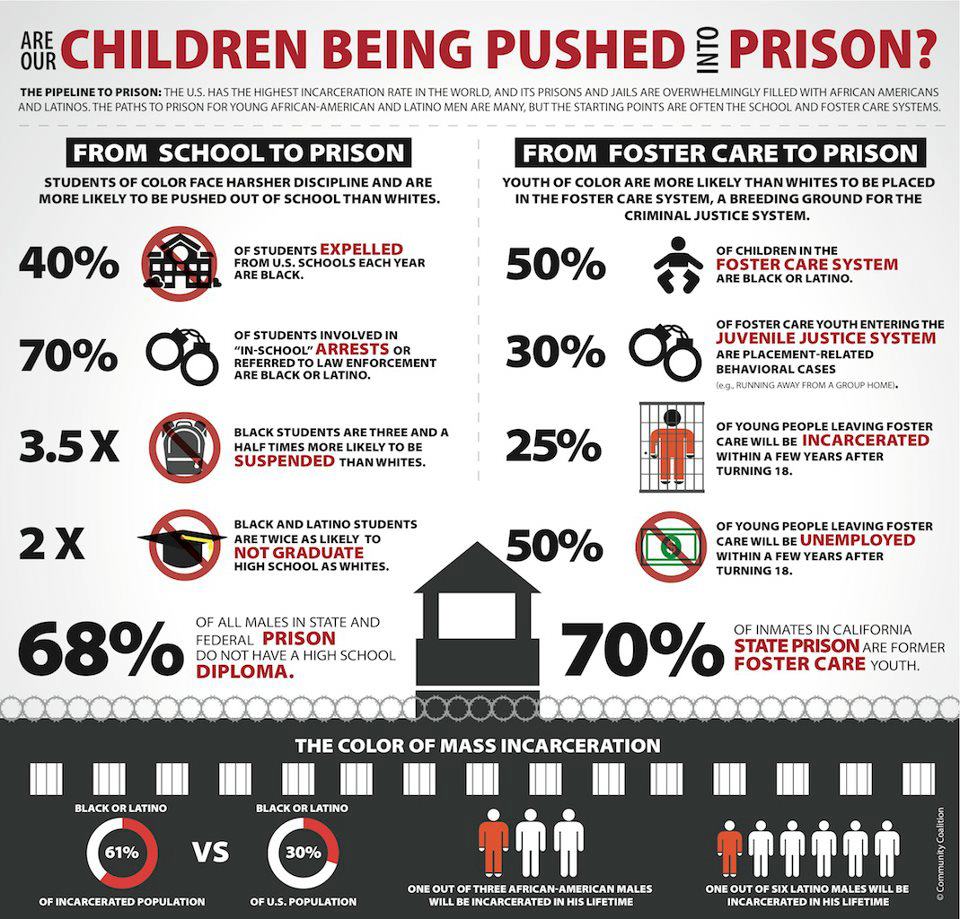
This following info graphic compacts information relating exactly to Omar, minority juveniles who became imprisoned.


info graphic from SuspensionStories.com

Snyder, Michael. "Mass Incarceration: 21 Amazing Facts About America's Obsession With Prison." Infowars. American Dream, 28 July 2014. Web. 22 Mar. 2017.

Borowski, Julie. "18 Facts You Need to Know About U.S. Prisons." Newsweek. Freedom Works, 18 Mar. 2016. Web. 22 Mar. 2017.


Sunday, March 19, 2017

Entry Five

Day Sixteen
(Got it)

I found something that is extremely similar to how I want to present information in my documentary. I contacted David Tucker, in order to get professional recommendations of films to watch to gather knowledge from. He told me "The most famous example that comes immediately to mind is The Thin Blue Line. It is a story of wrongful incarceration. It was groundbreaking in its day and has influenced many filmmakers since." 

Yes.

That's what I  am looking for. Thankfully it was on Netflix and I watched it, taking in every detail. Although not as contemporary as I would have liked for it to have been, it still gave me a lot of ideas about how to frame and pace interviews, how to incorporate not traditional elements(and make them blend seamlessly), "the bigger picture" of how my documentary would be as a whole if I were to produce the full piece, and dramatic reenactments (probably something I won't be able to do and something that won't really fit in my piece, but still something to think about).


Here is an excerpt from the film, the opening shots of the city along with the revolver cutaway around fifty seconds in are some concepts that I would love to incorporate in my documentary (Miami and Omar's crowbar)


  • Morris, E., Law, L., Lipson, M., Czapsky, S., Chappell, R., Barnes, P., Glass, P., ... Fourth Floor Productions. (2005). The Thin Blue Line. Santa Monica, CA: Metro Goldwyn Mayer Home Entertainment.

Entry Four

Day Fourteen
(local)

Omar's  
    I want to stop and think about what I have. I live near two immense, major cities full of diverse culture, Miami and Fort Lauderdale. I own a decent DSLR, tripod, microphone, and different lenses. I have music to use for any scenes I would want to have some. I have a willing subject with an interesting and important topic. I don't exactly have the questions I want to ask him, but I know how I want to present him. I have some decisions made already, like where I want to film him and who in his life I want involved in scenes. All this together makes a solid documentary that I know for certain I can make how I visualize it in my head. I found documentaries relating to this topic I want to watch,  The House I Live In(2012) and The Work(2017). The Work debuted at SXSW just this week and I think there will be absolutely no way to watch it unless I reach out to him, which I will. The stills I have seen and the description and accompanying acclaim really make me want to see it as it sounds to be similar to what I'm going for. The five minute excerpt I want to be my final project I have decided to also be the film's introduction. At first, I was concerned about not being able to use archived footage in this project, especially since they are one of the biggest tropes when it comes to documentaries relating to social issues. Now, I'm excited to create something unconventional. Like In Cold Blood by Truman Capote, I want something nonfiction that plays like a character driven narrative. Little interviews and when they are necessary, do them as indirectly as possible, let him tell the story as much as he can.